
POSH Training & Workplace Sexual Harassment Awareness Program Creating a safe, respectful and inclusive workplace requires more than having a POSH Policy on paper. Employees and members of the Internal Committee must understand their responsibilities, rights and the legal framework governing workplace sexual harassment. POSH Training Session Sharing a few glimpses from a recent POSH awareness and training session conducted for employees. The session focused on creating awareness around workplace sexual harassment, appropriate workplace conduct, reporting mechanisms, the role of the Internal Committee and the importance of maintaining a safe and respectful work environment. What Does POSH Training Cover? A comprehensive POSH training programme may cover: Understanding sexual harassment at the workplace The Prevention of Sexual Harassment of Women at Workplace Act, 2013 What constitutes unwelcome behaviour Workplace scenarios and practical examples Rights and responsibilities of employees Internal Committee (IC) structure and responsibilities Complaint and inquiry process Confidentiality and protection against retaliation Employer responsibilities under the POSH framework Creating a safe, respectful and inclusive workplace Why POSH Training Is Important POSH compliance is not limited to constituting an Internal Committee or adopting a workplace policy. Effective implementation requires awareness, training and a clear understanding of the responsibilities of employees, management and the Internal Committee. Regular POSH awareness programmes can help organisations build a workplace culture where inappropriate conduct is recognised, concerns can be raised through appropriate mechanisms and employees understand the importance of respectful professional behaviour. POSH & Internal Committee Training For Internal Committee members, training can additionally focus on their statutory responsibilities, handling complaints, preliminary assessment, inquiry procedure, principles of natural justice, confidentiality, documentation and other practical aspects of the inquiry process. DISCLAIMER: The photographs and information appearing on this page are shared solely for professional documentation, awareness and informational purposes in relation to POSH training and workplace awareness initiatives. This page is not intended to constitute an advertisement, marketing communication, sales promotion.
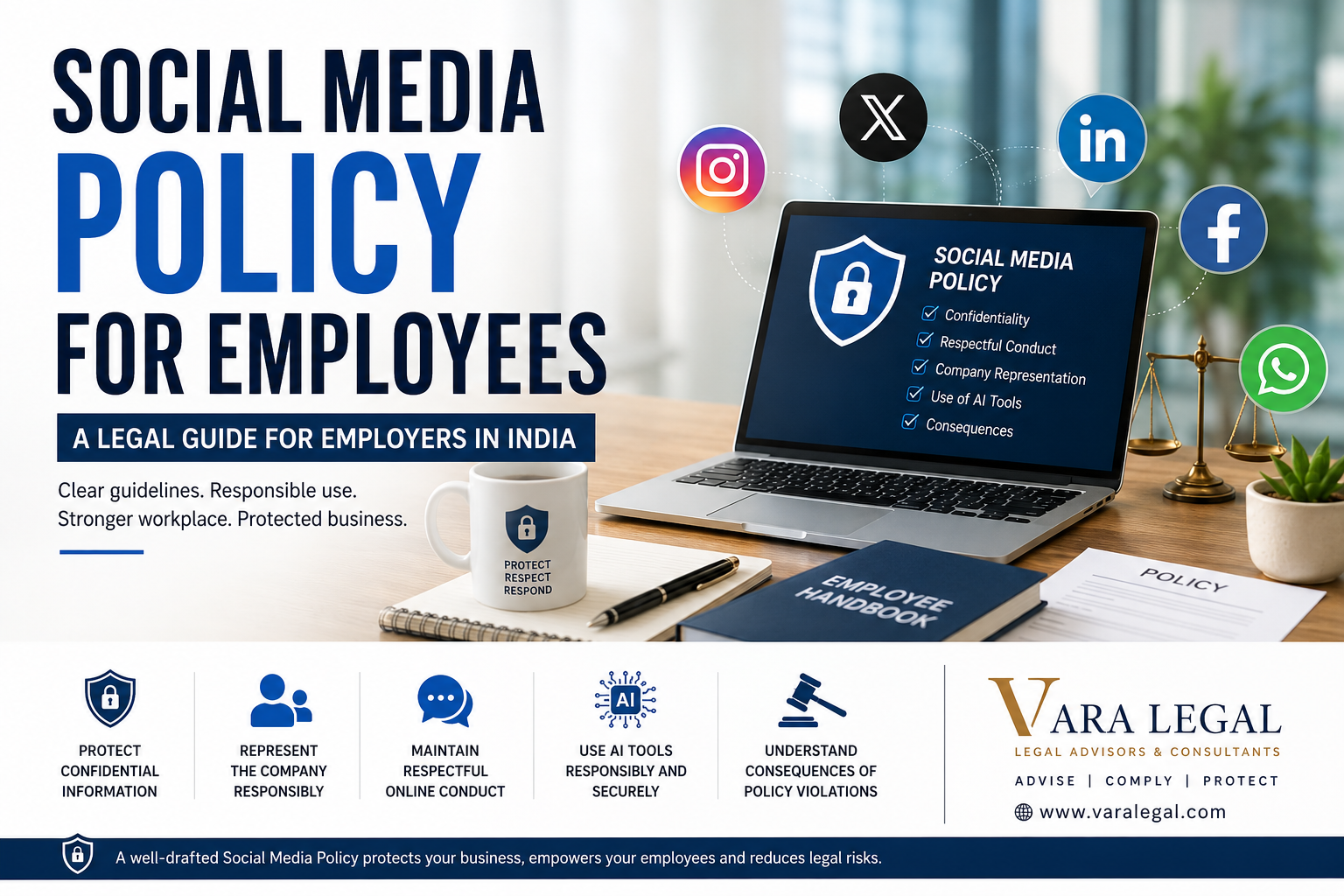
Social Media Policy for Employees in India: A Complete Legal Guide for Employers
Think about this for a moment. An employee shares a picture of their workstation on LinkedIn to celebrate a promotion. Harmless? Maybe. But what if that photograph unintentionally captures customer records, financial reports, an unreleased product design, or confidential business information in the background? A single post can create significant legal and commercial risks, even if there was no intention to cause harm. That’s exactly why every organisation needs clear guidelines on what can and cannot be shared online. Social media has become an integral part of our professional lives. Employees use LinkedIn to celebrate promotions, Instagram to share workplace moments, X to express personal opinions, and WhatsApp to communicate with colleagues and clients. While these platforms have created new opportunities for networking and brand building, they have also blurred the line between personal expression and professional responsibility. This raises a question that employers often ask: Can an employer tell employees what they can or cannot post on social media?Surprisingly, Indian law doesn’t have a single legislation that answers this question. Instead, the answer lies in a combination of employment contracts, company policies, confidentiality obligations, and laws such as the Information Technology Act, the Digital Personal Data Protection Act, 2023, the Copyright Act, and, in certain situations, the POSH Act. In other words, whether an employer can take action often depends on what was posted, where it was posted, and whether it affected the employer’s legitimate business interests. Now one more related question: Does Freedom of Speech Mean Employees Can Post Anything? This is perhaps one of the most common misconceptions. Employees certainly enjoy the freedom to express their personal views but this right is not absolute and is subject to the reasonable restrictions prescribed under Constitution of India. Moreover, the constitutional guarantee does not entitle an employee to disregard contractual obligations voluntarily undertaken during the course of employment. For example, an employee cannot ordinarily justify the disclosure of confidential business information, customer data, trade secrets, or proprietary documents merely by claiming a right to free speech. Similarly, making statements while presenting oneself as an authorised spokesperson of the organisation may have legal and commercial consequences. The objective of a Social Media Policy should therefore not be to restrict legitimate personal expression but to establish reasonable boundaries that protect the organisation’s confidential information, reputation, intellectual property, and legal interests. Common Mistakes Employers Make One of the most common mistakes employers make is adopting a generic Social Media Policy downloaded from the internet and assuming that it will adequately protect the organisation from legal or reputational risks. While such templates may appear comprehensive, they are rarely tailored to the organisation’s specific business operations, regulatory environment, or internal governance framework. A policy that is not aligned with the employer’s contractual documentation, disciplinary procedures, and operational realities is often of limited practical value and may be difficult to enforce. Another frequent oversight is treating the Social Media Policy as a standalone HR document rather than integrating it with the organisation’s broader compliance framework. In practice, the policy should operate in conjunction with employment contracts, confidentiality and non-disclosure obligations, codes of conduct, information security policies, data protection policies, intellectual property policies, whistleblower mechanisms, and disciplinary procedures. Inconsistencies between these documents may create ambiguity regarding employees’ obligations and weaken the employer’s position in the event of disciplinary or legal proceedings. Employers also tend to overlook the fact that social media risks vary significantly across industries. A healthcare organisation may need to focus on protecting patient confidentiality and sensitive personal data, whereas a technology company may be primarily concerned with safeguarding source code, proprietary algorithms, software architecture, and trade secrets. Similarly, manufacturing businesses may face risks relating to disclosure of product designs, production processes, and supply chain information, while financial institutions must also consider sector-specific regulatory obligations and market-sensitive information. A standardised policy cannot adequately address these distinct risk profiles. Another common mistake is drafting policies using vague or overly restrictive language. Broad prohibitions that simply require employees to “protect the company’s reputation” or “avoid negative comments” without clearly defining prohibited conduct may create uncertainty and lead to inconsistent enforcement. A legally sound policy should clearly identify the categories of information that are confidential, specify who is authorised to make public statements on behalf of the organisation, prescribe acceptable online conduct, outline reporting obligations, and clearly set out the consequences of non-compliance. Finally, many organisations fail to periodically review and update their Social Media Policy to reflect changes in technology, evolving workplace practices, and the applicable legal and regulatory landscape. The increasing use of generative AI tools, the growing importance of data protection, and the emergence of new digital platforms have fundamentally altered the nature of workplace communications. A policy drafted several years ago may no longer address the risks faced by modern organisations. A well drafted Social Media Policy should therefore not be viewed as a generic compliance document. It should be a carefully considered governance instrument, tailored to the organisation’s business model, industry-specific risks, regulatory obligations, contractual framework, and legitimate business interests. When appropriately drafted and consistently implemented, it not only mitigates legal and reputational risks but also provides employees with clear guidance on responsible and compliant use of social media. Whether you are a startup establishing workplace policies for the first time or a mature organisation reviewing your existing governance framework, investing in a legally sound and business-specific Social Media Policy is no longer optional. A policy tailored to your organisation’s operational realities and regulatory obligations is far more effective than a generic template and can prove invaluable when addressing workplace disputes or compliance concerns. DISCLAIMER: The contents of this article are intended to provide general guidance on the subject matter and should not be construed as legal advice or a substitute for professional legal consultation.
Wrongful Termination in India
Wrongful Termination in India: What Every Employer and Employee Should Know Imagine reporting to work on a Monday morning only to receive an email stating: “Your services stand terminated with immediate effect. Today shall be your last working day.” No explanation. No meeting. No opportunity to respond. No discussion regarding notice period or pending dues. The immediate question that comes to mind is: Can an employer legally terminate an employee like this? The answer is not as straightforward as a simple “yes” or “no.” Indian law recognises an employer’s right to terminate employment. At the same time, it also protects employees against arbitrary, unlawful and procedurally unfair termination in situations where statutory provisions, contractual obligations or established legal principles have been violated. This distinction is important because many employees assume that every termination is illegal, while many employers believe that payment of salary in lieu of notice gives them unrestricted discretion to dismiss employees. Neither proposition accurately reflects the legal position in India. Whether a termination is lawful depends upon several factors, including: the nature of employment; the terms of the employment contract; the applicable labour laws; whether the employee falls within the definition of a “workman” under applicable legislation; the reason for termination; and whether the employer followed the legally prescribed procedure before ending the employment relationship. This article examines the legal framework governing wrongful termination in India, the rights available to employees, the obligations imposed upon employers, and the practical steps organisations should take to minimise employment disputes. What is Wrongful Termination? Unlike many jurisdictions, Indian law does not contain a single statutory definition of “wrongful termination.” Instead, the concept has evolved through employment contracts, labour legislation and judicial interpretation. In simple terms, wrongful termination refers to the termination of employment in a manner that violates: applicable labour laws; the employment agreement; certified standing orders or service rules (where applicable); mandatory statutory procedures; principles of natural justice in disciplinary matters; or constitutional protections in the case of public employment. Therefore, the legality of a termination is determined not merely by why an employee was dismissed, but also how the employer reached that decision. For example, an employer may have genuine concerns regarding misconduct. However, if the employer dismisses the employee without following the disciplinary procedure required under the applicable law, service rules or contractual framework, the termination may be vulnerable to legal challenge. Similarly, terminating an employee in retaliation for raising concerns regarding workplace harassment, discrimination or statutory non-compliance may expose the employer to significant legal consequences. Is Every Unfair Termination Illegal? One of the most common misconceptions in employment law is that every termination perceived as “unfair” is necessarily unlawful. This is not correct. The law distinguishes between an unfair decision and an illegal decision. An employer may take a commercially difficult decision, such as terminating employment due to restructuring, redundancy or persistent poor performance, which may be perceived as unfair by the affected employee. However, if the employer complies with the applicable contractual and statutory requirements, such termination may still be legally sustainable. Conversely, an employer may have genuine reasons to terminate an employee but fail to comply with mandatory procedural requirements. In such cases, the termination itself may become legally vulnerable despite the underlying reasons being legitimate. This is why courts frequently examine not only the reasons for termination but also the procedure adopted by the employer before arriving at its decision. Why Wrongful Termination Cases Are Increasing in India Employment disputes have become increasingly common over the past decade. Several factors have contributed to this trend. 1. Growth of Start-ups and Fast-Scaling Businesses Many start-ups prioritise business growth over legal compliance during their early stages. Employment policies are often informal, documentation is inconsistent, and disciplinary procedures are either absent or poorly implemented. While such flexibility may assist operational efficiency in the short term, it often results in disputes when employment relationships deteriorate. 2. Organisational Restructuring Businesses regularly restructure operations due to market conditions, technological advancements, mergers, acquisitions and cost optimisation initiatives. Although employers are entitled to reorganise their workforce, restructuring exercises must still comply with applicable legal requirements and contractual obligations. 3. Performance-Based Exits Performance management has become increasingly data-driven. Employers frequently rely upon key performance indicators (KPIs), performance improvement plans (PIPs) and periodic evaluations. However, poor performance alone does not automatically justify immediate termination. Employers should maintain proper documentation, provide reasonable opportunities for improvement where appropriate, and ensure that internal policies are applied consistently. 4. Increased Employee Awareness Employees today have greater access to legal information through online resources and are increasingly willing to challenge termination decisions where they believe their legal rights have been infringed. This has led to greater scrutiny of termination processes and employment documentation. Wrongful Termination vs. Lawful Termination The distinction between lawful and wrongful termination is often misunderstood. Lawful Termination Potentially Wrongful Termination Based on genuine business requirements and carried out in accordance with law Termination in breach of statutory provisions or contractual obligations Compliance with contractual notice requirements No notice despite contractual requirement Fair disciplinary process where required Punitive dismissal without following applicable disciplinary procedures Payment of statutory dues Failure to pay legally payable dues Proper documentation supporting the decision Arbitrary or undocumented decision-making It is important to remember that no two employment disputes are identical. The legal consequences depend upon the applicable law, the employee’s status, the terms of employment and the factual background of each case.
FSSAI Compliance
What is FSSAI? The Food Safety and Standards Authority of India (FSSAI) is the apex regulatory body established under the Ministry of Health & Family Welfare, Government of India. It is responsible for ensuring food safety and regulating the manufacture, storage, distribution, sale, and import of food in India. Every Food Business Operator (FBO) in India must obtain either FSSAI Registration or FSSAI License, depending on the scale and nature of operations. Key FSSAI Compliance Requirements 1. FSSAI Registration and Licensing All FBOs must obtain prior registration or license before commencing operations. Three categories: FSSAI Basic Registration – for petty food businesses and small-scale operators State FSSAI License – for medium-sized businesses operating within one state Central FSSAI License – for large businesses, multi-state operations, exporters, and importers 2. Display of FSSAI License FSSAI license/registration number must be prominently displayed at the premises Mandatory printing on packaged food labels 3. Labeling and Packaging Compliance All packaged food must comply with FSSAI Packaging and Labeling Regulations, including: Ingredients list Nutritional information FSSAI license number Veg/Non-veg logo Expiry/best before date Manufacturer details 4.Record Keeping and Traceability FBOs must maintain: Raw material purchase records Production logs Storage and distribution records Sales records for traceability General FSSAI Compliance Checklist (All FBOs) Requirement Description FSSAI Registration/License Obtain appropriate category license Display of License Visible at premises and packaging Hygiene Compliance Follow Schedule 4 standards FSMS Implementation HACCP-based system mandatory Food Testing Regular lab testing of products Labeling Compliance Follow FSSAI labeling rules FoSTaC Training Train food handlers Record Maintenance Maintain traceability records Annual Returns File Form D1/D2 where applicable Consumer Grievance System Mechanism for complaints Food Recall System Emergency recall procedure Safe Water & Equipment Hygienic operations Pest Control Regular pest management No Adulteration Strict prohibition of unsafe additives Why FSSAI Compliance is Critical 🛡️ Legal Protection – Avoid penalties, suspension, and prosecution 🏷️ Consumer Trust – Enhances brand credibility 🚀 Business Expansion – Essential for scaling, exports, and partnerships ✅ Quality Assurance – Ensures consistent food safety standards 📈 Market Access – Mandatory for online platforms and institutional buyers This article is for general informational purposes only and does not constitute legal advice. Readers are advised to seek professional legal consultation for specific situations. The author assumes no liability for actions taken based on this content.
India doesn’t lack laws on women’s safety. It lacks something else IMPLEMENTATION
FSSAI: India’s Silent Food Police
Misleading Food Labels Under Scanner For years, most Indians looked at the FSSAI logo on food packets as a mere formality. But 2026 has changed that perception dramatically. The Food Safety and Standards Authority of India (FSSAI) has now become one of the most aggressive regulators in the country, targeting misleading branding, adulteration, hygiene violations, and fake “healthy” claims. And interestingly, the biggest brands are now under scrutiny. The “Healthy” Food Scam Under Scanner In June 2026, FSSAI issued notices to several food companies for allegedly misleading consumers through labels such as: “Healthy” “Organic” “Zero Maida” “Plant-Based Vegan” “True Vitamin” This marks a major shift in Indian food law. Earlier, the focus was mainly on adulteration. Now, FSSAI is also regulating consumer psychology and deceptive marketing. A packet saying “healthy” may now invite legal scrutiny if the claim cannot be scientifically justified. Mislabelled ORS Drinks Removed FSSAI also ordered the removal of several drinks falsely marketed as “ORS” in 2026. The regulator clarified that only products complying with medically recognized Oral Rehydration Solution standards can use the ORS label. This is significant because consumers often rely upon such drinks during dehydration or illness, assuming them to be medically safe. 2026 has revealed one important reality: Food law is no longer just about hygiene inspections. It now involves: Consumer protection False advertising Product liability Digital evidence Influencer marketing Public health accountability Businesses can no longer hide behind attractive packaging and technical loopholes. Conclusion India’s food industry is expanding rapidly, but so are consumer risks. From misleading “healthy” labels to adulterated products and viral contamination complaints, FSSAI is finally pushing food businesses toward accountability. For consumers, the lesson is simple: Never trust packaging blindly. And for food companies, compliance is no longer optional, it is reputational survival. #FSSAI,#Foodlaws,#Mislabelled,#Legalmetrology
POSH Compliance for Companies in India
The Sexual Harassment of Women at Workplace (Prevention, Prohibition and Redressal) Act, 2013 commonly known as the POSH Act, is no longer treated as a mere HR formality. In 2026, regulators, courts, investors, and employees are increasingly scrutinizing whether companies are genuinely compliant or merely maintaining paperwork. Non-compliance can expose organizations to legal penalties, reputational damage, employee attrition, and even investor concerns. Recent reports indicate that many organizations still fail to constitute proper Internal Committees (ICs), conduct training, or follow lawful inquiry procedures. Government authorities have also started workplace inspections and digital monitoring through the SHe-Box framework. What is the POSH Act? The POSH Act was enacted to: Prevent sexual harassment at workplaces Provide a complaint redressal mechanism Ensure a safe working environment for women The law applies across: Private companies Startups LLPs Hospitals NGOs Educational institutions Corporate offices Remote and hybrid workplaces The definition of “workplace” under the Act is intentionally broad and includes: Offices Work travel Virtual meetings Company events Offsite gatherings Transportation provided by employer Courts and experts increasingly recognize that workplace harassment is not restricted to physical office premises. Which Companies Must Comply with POSH? Every organization with 10 or more employees is required to constitute an Internal Committee (IC). The employee count includes: Permanent employees Interns Consultants Contract workers Temporary staff Apprentices Probationers Even startups crossing the 10-employee threshold are required to comply immediately. For establishments having fewer than 10 employees, complaints may be referred to the Local Committee constituted by the District Officer. Mandatory POSH Compliance Requirements for Companies Constitution of Internal Committee (IC) Under Section 4 of the POSH Act, every eligible employer must constitute an Internal Committee comprising: One senior woman employee as Presiding Officer Minimum two employee members One external member familiar with women’s rights or social work At least 50% women members Improper constitution of the IC can invalidate the entire inquiry process. POSH Policy Every employer should have a comprehensive POSH policy covering: Definition of sexual harassment Complaint procedure Inquiry process Confidentiality obligations Disciplinary actions Protection against retaliation A generic HR policy alone is insufficient. Employee Awareness & POSH Training Section 19 of the POSH Act imposes a duty upon employers to conduct: Awareness workshops Employee sensitization sessions IC member training Leadership orientation Many organizations fail compliance because training is conducted only on paper. Display of Notices Employers are required to display: POSH policy Consequences of sexual harassment Details of IC members Complaint process These notices should be visible at conspicuous places in the workplace. Timely Inquiry Process The POSH Act prescribes statutory timelines: Complaint filing: Within 3 months Inquiry completion: Within 90 days Employer action: Within 60 days from report Failure to adhere to timelines may expose the organization to legal challenge. Annual POSH Report Organizations are required to file annual reports containing: Number of complaints received Complaints resolved Pending matters Awareness programs conducted Several authorities now actively monitor annual POSH filings and disclosures. Penalties for Non-Compliance Under Section 26 of the POSH Act: First violation may attract penalty up to ₹50,000 Repeat violations may lead to: Cancellation of license Withdrawal of registration Regulatory action However, financial penalties are only one aspect. The larger risks include: Reputational harm Social media exposure Litigation Employee distrust Investor due diligence concerns Startups have reportedly faced investor scrutiny solely due to missing POSH compliance frameworks. Recent Legal Developments in POSH Recent judicial and regulatory developments indicate stricter enforcement trends: Delhi High Court on Parallel Inquiries The Delhi High Court recently clarified that employers cannot bypass the statutory POSH mechanism through parallel investigations. Government Workplace Inspections Authorities have initiated inspections to verify: Proper IC constitution Training records Complaint mechanisms Policy implementation SHe-Box Monitoring The Government’s SHe-Box portal has enhanced digital oversight for workplace harassment complaints. Common Mistakes Companies Make Organizations often assume they are compliant merely because: They have an HR department An anti-harassment clause exists in employment contracts No complaint has been received In reality, common lapses include: Non-functional ICs Improper external members Lack of training documentation Failure to maintain confidentiality Procedural irregularities during inquiry These lapses can significantly weaken the company’s legal position. Why POSH Compliance is Important Beyond Law Effective POSH implementation helps organizations: Build safer workplaces Improve employee trust Reduce legal exposure Strengthen ESG and governance standards Enhance investor confidence Protect brand reputation Modern compliance expectations now treat POSH as a governance obligation rather than merely an HR responsibility. FAQs on POSH Compliance Is POSH mandatory for startups? Yes. Once a startup has 10 or more employees, constituting an Internal Committee becomes mandatory. Is POSH applicable to work-from-home situations? Yes. Virtual workplaces and remote interactions can fall within the scope of the POSH Act. Can complaints be filed after resignation? Yes, in certain cases, provided the incident occurred during employment. Does POSH apply during office parties? Yes, office outings and work-related social gatherings may qualify as workplace extensions. Can employers conduct separate investigations outside POSH? Courts have increasingly discouraged parallel mechanisms that bypass the statutory process.
Healthcare Data Privacy in India
Beyond the DPDP Act: The Expanding Framework of Data Privacy in India’s Healthcare Sector Healthcare data is among the most sensitive categories of personal information. Unlike ordinary personal data, medical records expose an individual’s physical condition, mental health, genetic traits, reproductive choices, disabilities, and even financial vulnerabilities. In the digital era where hospitals, telemedicine platforms, insurance providers, pharmacies, wearable devices, and AI diagnostic systems continuously process patient information protecting healthcare data is no longer merely a compliance obligation. It has become a constitutional necessity and a question of public trust. Much of the recent discussion in India revolves around the Digital Personal Data Protection Act, 2023 (DPDP Act). While the DPDP Act undoubtedly forms the backbone of India’s emerging privacy regime, healthcare data privacy in India is governed by a far wider and fragmented legal ecosystem. Several sectoral laws, constitutional principles, ethical regulations, cybersecurity rules, and judicial precedents collectively shape the obligations of healthcare institutions. This article examines the broader legal architecture governing healthcare data privacy in India and argues that healthcare privacy must be viewed through a multi-layered regulatory lens rather than through the DPDP Act alone. Healthcare Data: Why It Requires Special Protection Healthcare information differs fundamentally from ordinary personal data because of its permanence and sensitivity. A leaked password can be changed; a leaked diagnosis cannot. Medical data may expose conditions relating to HIV status, psychiatric illnesses, infertility treatment, gender transition, or genetic disorders information capable of causing discrimination, stigma, and social exclusion. The digitization of healthcare through electronic health records (EHRs), telemedicine, health-tech startups, and AI-driven diagnostics has significantly increased both the utility and vulnerability of health data. Cyberattacks on hospitals, unauthorized data sharing by applications, and insurance profiling practices have demonstrated that healthcare institutions are increasingly attractive targets for data exploitation. Consequently, legal protection of healthcare data is no longer only about confidentiality between doctor and patient; it is also about cybersecurity, consent architecture, algorithmic accountability, and informational self-determination. Constitutional Foundation: Privacy as a Fundamental Right The legal foundation for healthcare data privacy in India originates not from the DPDP Act but from the landmark judgment in Justice K.S. Puttaswamy v. Union of India (2017), where the Supreme Court recognized privacy as a fundamental right under Article 21 of the Constitution. The judgment emphasized informational privacy and acknowledged that individuals must retain control over dissemination of personal information. Importantly, the Court recognized that medical records form part of the “zone of privacy” deserving constitutional protection. This constitutional recognition transformed data privacy from a contractual or statutory issue into a rights-based framework. Healthcare entities therefore do not merely handle data; they process constitutionally protected personal information. The DPDP Act, 2023: A General Framework, Not a Complete Code The DPDP Act introduced India’s first comprehensive data protection framework and applies to digital personal data processed within India. Healthcare providers, hospitals, laboratories, telemedicine companies, insurers, and health-tech platforms fall within its scope when processing patient information. The Act imposes obligations relating to: lawful processing of personal data; informed consent; purpose limitation; data minimization; reasonable security safeguards; and grievance redressal mechanisms. Healthcare organizations must also notify breaches and ensure that data is processed only for legitimate purposes. However, the DPDP Act is not healthcare-specific. It does not comprehensively address: medical confidentiality; doctor-patient privilege; genetic data governance; clinical research ethics; AI-based medical profiling; or cross-border health data interoperability. Therefore, relying solely on the DPDP Act provides an incomplete understanding of healthcare privacy obligations. Information Technology Act and SPDI Rules Before the DPDP Act, healthcare privacy was primarily regulated under the Information Technology Act, 2000 and the Sensitive Personal Data or Information Rules, 2011 (SPDI Rules). The SPDI Rules explicitly classify: physical health conditions; medical records; and biometric information as “sensitive personal data or information.” Under these rules, body corporates handling health data are required to: obtain consent before collection; maintain privacy policies; implement reasonable security practices; and prevent unauthorized disclosure. Although the DPDP Act has altered the legal landscape, the IT Act continues to remain relevant, especially in relation to cybersecurity obligations and compensation for negligent handling of sensitive information under Section 43A. In practice, hospitals may face overlapping obligations under both the IT framework and the DPDP regime until full regulatory harmonization occurs. National Digital Health Mission and ABDM Framework India’s healthcare ecosystem is undergoing rapid digitization through the Ayushman Bharat Digital Mission (ABDM), which seeks to create interoperable digital health infrastructure. The ABDM framework introduces: Health IDs; digital health records; consent managers; and health information exchanges. While the initiative promises efficiency and accessibility, it also creates unprecedented centralized repositories of medical data. The Health Data Management Policy under ABDM attempts to incorporate privacy principles such as: consent-based sharing; purpose limitation; audit trails; and user control. However, concerns remain regarding: re-identification risks; data centralization; private-sector access; cybersecurity vulnerabilities; and surveillance implications. The future of healthcare privacy in India will depend significantly on how ABDM balances innovation with constitutional privacy safeguards. Medical Ethics and Professional Confidentiality Long before data protection statutes emerged, patient confidentiality existed as an ethical obligation under medical jurisprudence. The National Medical Commission’s Code of Ethics imposes duties on medical practitioners to maintain confidentiality of patient information except in legally justified circumstances. This ethical obligation creates an additional layer of accountability. Even where statutory privacy provisions are ambiguous, healthcare professionals may still face disciplinary consequences for unauthorized disclosures. The principle of confidentiality also intersects with tort law, contractual obligations, and consumer protection claims. Telemedicine and Digital Health Platforms The rise of telemedicine platforms has expanded privacy concerns beyond traditional hospitals. Telemedicine Practice Guidelines issued by the Government of India require registered medical practitioners to maintain confidentiality and ensure secure handling of patient information during virtual consultations. However, digital health platforms often collect far more information than necessary, including: location data; behavioral patterns; device identifiers; and lifestyle metrics. Many health applications share data with advertisers, analytics companies, or third-party service providers without meaningful informed consent. This raises an important question: when healthcare becomes platform, should patient data be treated

Direct Selling Compliance: The Hidden Key to Long Term Growth
The direct selling industry is no longer what it was 10 years ago. Today’s successful direct selling companies are not built merely on products, aggressive recruitment, or motivational seminars. They are built on compliance, consumer trust, technology, legal clarity, and sustainable compensation structures. Yet, despite the market potential, a large number of direct selling businesses collapse within the first few years. Why? Because most founders focus on growth before structure. And in direct selling, that is the fastest route to regulatory scrutiny, distributor distrust, and operational instability. The Biggest Misconception in Direct Selling Many entrepreneurs still believe that direct selling is “easy scaling.” Launch a product. Create a network. Offer commissions. Grow aggressively. But modern regulators, consumers, and even distributors are asking deeper questions: Is the compensation model legally sustainable? Is the business genuinely product-driven? Are distributor earnings realistic and transparent? Does the company comply with evolving direct selling regulations? Is the documentation legally defensible? The companies that survive are the ones that answer these questions before expansion. The Industry Has Changed Permanently Governments across the world are tightening oversight on direct selling models. Consumers are more aware. Distributors are more cautious. Digital footprints are permanent. And Social media amplifies both credibility and controversy instantly. In this environment, a poorly structured direct selling company is not just risky — it is vulnerable. What worked in the past no longer works today. Modern direct selling businesses require: Strong legal architecture Clear distributor agreements Ethical compensation frameworks Consumer-centric policies Regulatory alignment Reputation management Transparent operational systems Without these, scaling becomes dangerous instead of profitable. The Difference Between a Network and a Real Business A real direct selling business creates long term consumer demand. A weak direct selling business survives only on recruitment momentum. That distinction matters enormously. The strongest direct selling companies in today’s market understand that sustainability comes from: Product retention Customer loyalty Distributor confidence Compliance-first growth Long-term brand credibility Not hype. Not pressure selling. Not unrealistic income projections. The future belongs to businesses that combine entrepreneurship with governance. Why Founders Need Strategic Guidance Early One of the most expensive mistakes founders make is seeking professional advice only after problems begin. By the time notices arrive, payment gateways freeze, distributors complain, or regulators start asking questions the damage is already significant. Strong companies are built proactively. The smartest founders today are investing early in: Business structuring Compensation plan analysis Compliance systems Distributor documentation Internal policies Risk assessment Regulatory positioning Because prevention is always cheaper than crisis management. The Real Opportunity in Direct Selling Despite the challenges, direct selling remains one of the most powerful business models when executed correctly. Why? Because it combines: Entrepreneurship Community-driven growth Product scalability Distribution efficiency Personal branding Digital commerce But only disciplined businesses will dominate the next decade. The era of “fast money” models is fading. The era of professionally structured direct selling companies has begun. Final Thought Direct selling is not dying. It is evolving. And the businesses that understand compliance, ethics, strategy, and long-term positioning will lead the industry forward. The future will not belong to the loudest Direct Selling companies. It will belong to the most credible ones. #DirectSelling #NetworkMarketing #MLM #BusinessCompliance #Entrepreneurship #DirectSellingIndia #LegalStrategy #BusinessGrowth
Direct Selling Compliance in India 2026: Legal Requirements for MLM & Network Marketing Companies
The direct selling industry in India has emerged as a legally recognised and rapidly expanding sector, regulated primarily under the Consumer Protection (Direct Selling) Rules, 2021, along with the 2023 amendments issued under the Consumer Protection Act, 2019. The regulatory environment has continued to evolve in recent years. Amendments introduced in 2023 clarified the legal definition of direct selling, while the 2025 reforms to consumer protection enforcement established mandatory online grievance mechanisms and imposed a 90-day timeline for dispute resolution. In addition, a July 2024 notification issued by the Food Safety and Standards Authority of India (FSSAI) introduced a specialised compliance category for direct sellers dealing in food and wellness products. This memorandum outlines the current legal framework, compliance obligations, prohibited activities, and regulatory considerations relevant to entities operating in the Indian direct selling sector. Historical and Legislative Context Before 2021, India did not have a dedicated legal framework governing direct selling. As a result, businesses in the sector often faced scrutiny under the Prize Chits and Money Circulation Scheme (Banning) Act, 1978. Formal statutory recognition of “direct selling” was introduced through Section 2(13) of the Consumer Protection Act, 2019, which defines the activity as the marketing, distribution, and sale of goods or services through a network of sellers rather than permanent retail outlets. Subsequent amendments and regulatory notifications have refined this framework over time. Current Legal Framework (as of 3 May 2026) The regulatory structure applicable to direct selling in India is multi-dimensional and involves several interrelated statutes and regulations: Consumer Protection (Direct Selling) Rules, 2021 (as amended in 2023): These rules establish the primary compliance framework, define key concepts, and prescribe obligations for direct selling entities (DSEs) and direct sellers. Consumer Protection Act, 2019 (including 2025 reforms): Provides broader consumer rights protections, including online complaint filing, stricter accountability standards, and accelerated adjudication timelines. Companies Act, 2013 and LLP Act, 2008: Require DSEs to be duly incorporated prior to commencing operations in India. Income Tax and GST Laws: Mandate PAN, TAN, and GST registration along with maintenance and filing of tax records. Food Safety and Standards Act, 2006: Requires food and nutraceutical direct sellers to register under the dedicated “Direct Seller” category introduced in FoSCoS during 2024. Foreign Exchange Management Act, 1999 and FDI Policy: Govern foreign investment structures and compliance obligations applicable to overseas direct selling entities operating in India. Prize Chits and Money Circulation Scheme (Banning) Act, 1978: Continues to prohibit fraudulent money circulation and pyramid schemes. Registration and Structural Compliance Any DSE intending to operate in India must complete several pre-operational formalities, including: Registration with the Department for Promotion of Industry and Internal Trade (DPIIT). Incorporation as a company, partnership firm, or LLP. Establishment of a registered office within India. Procurement of PAN, TAN, and GSTIN registrations. Acquisition of sector-specific licences, including FSSAI or CDSCO approvals where applicable. Maintenance of a functional website containing details of products, pricing, grievance mechanisms, and contact information. Entities are also required to maintain statutory and financial records at their registered office, including incorporation documents, tax filings, audited financial statements, and records of direct sellers and customer transactions. Mandatory Compliance Officers The Rules require DSEs to appoint designated officers, including: A Chief Compliance Officer, responsible for legal and regulatory compliance; A Nodal Contact Person, who must be an Indian resident available for coordination with law enforcement authorities; and A Grievance Officer, responsible for acknowledging complaints within 48 hours and resolving them within one month. Duties and Obligations of Direct Selling Entities DSEs are subject to extensive operational and consumer protection obligations. These include: Maintaining transparent and regularly updated online disclosures; Executing written agreements with direct sellers; Monitoring the conduct of network participants; Ensuring consumer data remains stored within India; and Prohibiting entry fees or registration charges for participation in the business model. Consumer protection duties include timely delivery of goods, mandatory acceptance of returns for defective products, and transparent disclosure of cancellation and refund rights. Under the 2025 reforms, complaints filed through the government’s centralised online portal must be acknowledged within 48 hours and resolved within 30 days. Restrictions and Prohibited Practices The regulatory framework imposes strict prohibitions on activities commonly associated with unlawful schemes. These include: Pyramid structures where compensation is driven primarily by recruitment rather than product sales; Money circulation schemes prohibited under the 1978 Act; Charging joining or subscription fees; Misleading or deceptive marketing practices; and Unverified health or medical claims relating to products. Direct sellers are additionally prohibited from visiting consumers without prior appointments or identity verification and may not distribute unauthorised promotional material. Consumer Rights and Cooling-Off Period Consumers are entitled to receive complete product and compensation plan disclosures before enrolment or purchase. They also possess rights relating to refunds, complaint resolution, and data privacy. Although the Rules do not prescribe a mandatory cooling-off period, industry practice generally recommends a minimum period of 30 days for cancellation without penalty. Applicability to Foreign Direct Selling Entities The Direct Selling Rules apply not only to Indian entities but also to foreign-incorporated businesses offering goods or services to consumers in India. Overseas DSEs must therefore: Maintain a registered office in India; Appoint resident compliance officers; Ensure Indian consumer data remains within India; and Structure investments in compliance with FEMA and FDI regulations. The RBI’s expanded 2025 interpretation of “control” has increased scrutiny of layered ownership structures and indirect foreign influence arrangements. Regulatory and Industry Bodies Key authorities and industry organisations relevant to the sector include: The Ministry of Consumer Affairs; DPIIT; The Indian Direct Selling Association (IDSA); The Federation of Indian Direct Selling Industries (FIDSI); FSSAI; and State-level regulatory authorities. Industry Overview India’s direct selling market has experienced substantial growth in recent years. By 2025, the sector accounted for approximately 5.7% of global direct selling revenue, with health and wellness products contributing the largest share of industry earnings. Cosmetics and personal care products represent the fastest-growing segment, while the industry continues to generate large-scale employment and entrepreneurial opportunities, particularly for women. Emerging Regulatory Trends Several developments are expected