
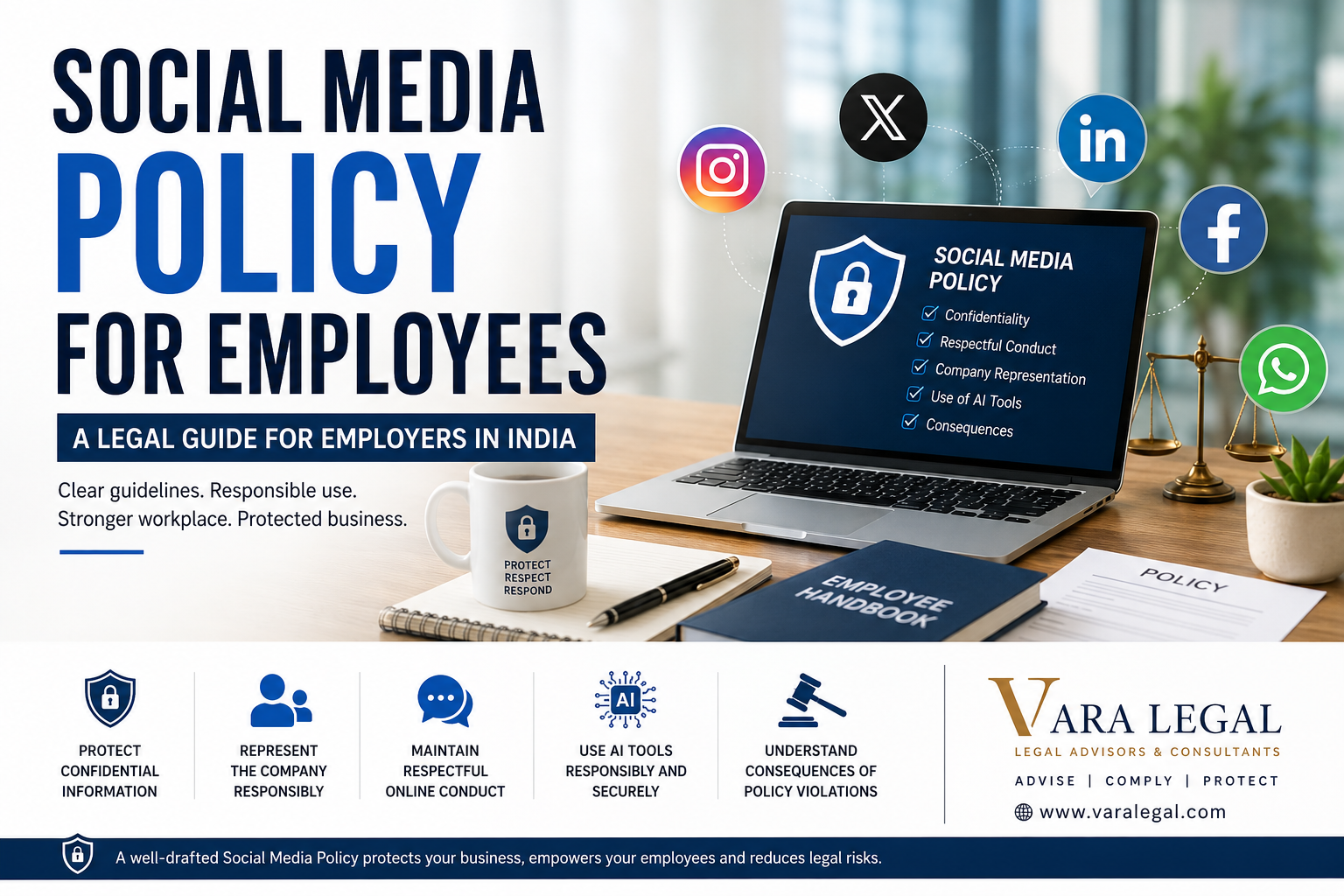
Think about this for a moment. An employee shares a picture of their workstation on LinkedIn to celebrate a promotion. Harmless? Maybe. But what if that photograph unintentionally captures customer records, financial reports, an unreleased product design, or confidential business information in the background? A single post can create significant legal and commercial risks, even if there was no intention to cause harm. That’s exactly why every organisation needs clear guidelines on what can and cannot be shared online. Social media has become an integral part of our professional lives. Employees use LinkedIn to celebrate promotions, Instagram to share workplace moments, X to express personal opinions, and WhatsApp to communicate with colleagues and clients. While these platforms have created new opportunities for networking and brand building, they have also blurred the line between personal expression and professional responsibility. This raises a question that employers often ask: Can an employer tell employees what they can or cannot post on social media?Surprisingly, Indian law doesn’t have a single legislation that answers this question. Instead, the answer lies in a combination of employment contracts, company policies, confidentiality obligations, and laws such as the Information Technology Act, the Digital Personal Data Protection Act, 2023, the Copyright Act, and, in certain situations, the POSH Act. In other words, whether an employer can take action often depends on what was posted, where it was posted, and whether it affected the employer’s legitimate business interests. Now one more related question: Does Freedom of Speech Mean Employees Can Post Anything? This is perhaps one of the most common misconceptions. Employees certainly enjoy the freedom to express their personal views but this right is not absolute and is subject to the reasonable restrictions prescribed under Constitution of India. Moreover, the constitutional guarantee does not entitle an employee to disregard contractual obligations voluntarily undertaken during the course of employment. For example, an employee cannot ordinarily justify the disclosure of confidential business information, customer data, trade secrets, or proprietary documents merely by claiming a right to free speech. Similarly, making statements while presenting oneself as an authorised spokesperson of the organisation may have legal and commercial consequences. The objective of a Social Media Policy should therefore not be to restrict legitimate personal expression but to establish reasonable boundaries that protect the organisation’s confidential information, reputation, intellectual property, and legal interests. Common Mistakes Employers Make One of the most common mistakes employers make is adopting a generic Social Media Policy downloaded from the internet and assuming that it will adequately protect the organisation from legal or reputational risks. While such templates may appear comprehensive, they are rarely tailored to the organisation’s specific business operations, regulatory environment, or internal governance framework. A policy that is not aligned with the employer’s contractual documentation, disciplinary procedures, and operational realities is often of limited practical value and may be difficult to enforce. Another frequent oversight is treating the Social Media Policy as a standalone HR document rather than integrating it with the organisation’s broader compliance framework. In practice, the policy should operate in conjunction with employment contracts, confidentiality and non-disclosure obligations, codes of conduct, information security policies, data protection policies, intellectual property policies, whistleblower mechanisms, and disciplinary procedures. Inconsistencies between these documents may create ambiguity regarding employees’ obligations and weaken the employer’s position in the event of disciplinary or legal proceedings. Employers also tend to overlook the fact that social media risks vary significantly across industries. A healthcare organisation may need to focus on protecting patient confidentiality and sensitive personal data, whereas a technology company may be primarily concerned with safeguarding source code, proprietary algorithms, software architecture, and trade secrets. Similarly, manufacturing businesses may face risks relating to disclosure of product designs, production processes, and supply chain information, while financial institutions must also consider sector-specific regulatory obligations and market-sensitive information. A standardised policy cannot adequately address these distinct risk profiles. Another common mistake is drafting policies using vague or overly restrictive language. Broad prohibitions that simply require employees to “protect the company’s reputation” or “avoid negative comments” without clearly defining prohibited conduct may create uncertainty and lead to inconsistent enforcement. A legally sound policy should clearly identify the categories of information that are confidential, specify who is authorised to make public statements on behalf of the organisation, prescribe acceptable online conduct, outline reporting obligations, and clearly set out the consequences of non-compliance. Finally, many organisations fail to periodically review and update their Social Media Policy to reflect changes in technology, evolving workplace practices, and the applicable legal and regulatory landscape. The increasing use of generative AI tools, the growing importance of data protection, and the emergence of new digital platforms have fundamentally altered the nature of workplace communications. A policy drafted several years ago may no longer address the risks faced by modern organisations. A well drafted Social Media Policy should therefore not be viewed as a generic compliance document. It should be a carefully considered governance instrument, tailored to the organisation’s business model, industry-specific risks, regulatory obligations, contractual framework, and legitimate business interests. When appropriately drafted and consistently implemented, it not only mitigates legal and reputational risks but also provides employees with clear guidance on responsible and compliant use of social media. Whether you are a startup establishing workplace policies for the first time or a mature organisation reviewing your existing governance framework, investing in a legally sound and business-specific Social Media Policy is no longer optional. A policy tailored to your organisation’s operational realities and regulatory obligations is far more effective than a generic template and can prove invaluable when addressing workplace disputes or compliance concerns. DISCLAIMER: The contents of this article are intended to provide general guidance on the subject matter and should not be construed as legal advice or a substitute for professional legal consultation.
POSH Compliance for Companies in India
The Sexual Harassment of Women at Workplace (Prevention, Prohibition and Redressal) Act, 2013 commonly known as the POSH Act, is no longer treated as a mere HR formality. In 2026, regulators, courts, investors, and employees are increasingly scrutinizing whether companies are genuinely compliant or merely maintaining paperwork. Non-compliance can expose organizations to legal penalties, reputational damage, employee attrition, and even investor concerns. Recent reports indicate that many organizations still fail to constitute proper Internal Committees (ICs), conduct training, or follow lawful inquiry procedures. Government authorities have also started workplace inspections and digital monitoring through the SHe-Box framework. What is the POSH Act? The POSH Act was enacted to: Prevent sexual harassment at workplaces Provide a complaint redressal mechanism Ensure a safe working environment for women The law applies across: Private companies Startups LLPs Hospitals NGOs Educational institutions Corporate offices Remote and hybrid workplaces The definition of “workplace” under the Act is intentionally broad and includes: Offices Work travel Virtual meetings Company events Offsite gatherings Transportation provided by employer Courts and experts increasingly recognize that workplace harassment is not restricted to physical office premises. Which Companies Must Comply with POSH? Every organization with 10 or more employees is required to constitute an Internal Committee (IC). The employee count includes: Permanent employees Interns Consultants Contract workers Temporary staff Apprentices Probationers Even startups crossing the 10-employee threshold are required to comply immediately. For establishments having fewer than 10 employees, complaints may be referred to the Local Committee constituted by the District Officer. Mandatory POSH Compliance Requirements for Companies Constitution of Internal Committee (IC) Under Section 4 of the POSH Act, every eligible employer must constitute an Internal Committee comprising: One senior woman employee as Presiding Officer Minimum two employee members One external member familiar with women’s rights or social work At least 50% women members Improper constitution of the IC can invalidate the entire inquiry process. POSH Policy Every employer should have a comprehensive POSH policy covering: Definition of sexual harassment Complaint procedure Inquiry process Confidentiality obligations Disciplinary actions Protection against retaliation A generic HR policy alone is insufficient. Employee Awareness & POSH Training Section 19 of the POSH Act imposes a duty upon employers to conduct: Awareness workshops Employee sensitization sessions IC member training Leadership orientation Many organizations fail compliance because training is conducted only on paper. Display of Notices Employers are required to display: POSH policy Consequences of sexual harassment Details of IC members Complaint process These notices should be visible at conspicuous places in the workplace. Timely Inquiry Process The POSH Act prescribes statutory timelines: Complaint filing: Within 3 months Inquiry completion: Within 90 days Employer action: Within 60 days from report Failure to adhere to timelines may expose the organization to legal challenge. Annual POSH Report Organizations are required to file annual reports containing: Number of complaints received Complaints resolved Pending matters Awareness programs conducted Several authorities now actively monitor annual POSH filings and disclosures. Penalties for Non-Compliance Under Section 26 of the POSH Act: First violation may attract penalty up to ₹50,000 Repeat violations may lead to: Cancellation of license Withdrawal of registration Regulatory action However, financial penalties are only one aspect. The larger risks include: Reputational harm Social media exposure Litigation Employee distrust Investor due diligence concerns Startups have reportedly faced investor scrutiny solely due to missing POSH compliance frameworks. Recent Legal Developments in POSH Recent judicial and regulatory developments indicate stricter enforcement trends: Delhi High Court on Parallel Inquiries The Delhi High Court recently clarified that employers cannot bypass the statutory POSH mechanism through parallel investigations. Government Workplace Inspections Authorities have initiated inspections to verify: Proper IC constitution Training records Complaint mechanisms Policy implementation SHe-Box Monitoring The Government’s SHe-Box portal has enhanced digital oversight for workplace harassment complaints. Common Mistakes Companies Make Organizations often assume they are compliant merely because: They have an HR department An anti-harassment clause exists in employment contracts No complaint has been received In reality, common lapses include: Non-functional ICs Improper external members Lack of training documentation Failure to maintain confidentiality Procedural irregularities during inquiry These lapses can significantly weaken the company’s legal position. Why POSH Compliance is Important Beyond Law Effective POSH implementation helps organizations: Build safer workplaces Improve employee trust Reduce legal exposure Strengthen ESG and governance standards Enhance investor confidence Protect brand reputation Modern compliance expectations now treat POSH as a governance obligation rather than merely an HR responsibility. FAQs on POSH Compliance Is POSH mandatory for startups? Yes. Once a startup has 10 or more employees, constituting an Internal Committee becomes mandatory. Is POSH applicable to work-from-home situations? Yes. Virtual workplaces and remote interactions can fall within the scope of the POSH Act. Can complaints be filed after resignation? Yes, in certain cases, provided the incident occurred during employment. Does POSH apply during office parties? Yes, office outings and work-related social gatherings may qualify as workplace extensions. Can employers conduct separate investigations outside POSH? Courts have increasingly discouraged parallel mechanisms that bypass the statutory process.